St. Petersburg, FL · Operations, systems and the site in front of them
We fix the parts of your business that only work when somebody remembers.
Granchi Digital is an operations firm in St. Petersburg. We look at how a job actually moves through your business, from the inquiry that comes in to the invoice that gets paid, and we build the parts that are missing. Sometimes that includes the website, because the site is where the work arrives.
- St. Petersburg, FL
- Built on your accounts, not ours
- Scoped on a call, priced before work starts
- 01 INTAKEEvery inquiry lands somewhere, and somebody owns it.
- 02 THE JOBOne job number, with the photo, the note, the quote and the invoice on it.
- 03 THE FRONT DOORThe site customers arrive through, when that is the broken part.
Fig. 01 · What we fix
None of this is your business being run badly.
It is your business running on somebody's memory, and memory is the part that gets full. Read down this list and count the ones you recognize.
- 01A customer filled in the form and nobody ever saw it.
- 02The quote went out, went quiet, and nobody chased it.
- 03The same job typed into three apps, because it always has been.
- 04The invoice that gets written at nine that evening, or does not get written.
- 05The review nobody answered, because writing the same thank you is nobody's favorite job.
- 06The inquiry that arrived at seven and got its first answer on Tuesday.
- 07The paperwork around the work, which costs you the day the work did not.
Fig. 02 · What an engagement builds
Five shapes. Which of them you need is what the call is for.
Intake that cannot drop anything.
Your website form, your tracked phone line and your inbox feed one place. If nobody claims the job, somebody gets told.
Follow up that runs on a status, not on memory.
Every lead, quote and job carries a status, and the status queues the next message. The chasing stops the second the status changes.
One job number, everything attached to it.
The photo, the note, the quote and the invoice land on one record, without anybody typing it twice.
One screen for how you actually run.
Your work by stage, what each job is still missing, and who is sitting on it. Read only wherever read only is safer, so there is no second system to keep updated.
An assistant that drafts and waits.
It reads, sorts, drafts and flags. It does not send to your customer, bill your customer or write to your books on its own. It fails toward extra review, never toward a job marked complete.
Pick the one that looks like yours.
Three pictures of how this lands, by trade: restaurants and bars, where the money leaks between the POS, the phone and the listing; home services, where the lead you answered second is the job you lost; small offices, where the paperwork costs the day.
The money leaks between the POS, the phone and the listing.
Single location, bars, cafes
- Every new Google review has a reply already drafted and waiting on your yes. Written against what the guest actually said, in your voice, sent to your phone. You approve it, it posts. Nobody writes the same thank you over and over.
- The party and catering inquiry stops dying in your inbox. It becomes a record instead of an email you meant to answer: an instant reply with your minimums and open dates, a deposit link, and a nudge to both of you if it goes quiet.
- An 8am text with last night's numbers and only what looks wrong. Sales by daypart, covers, labor against sales, comps and voids. Quiet on a normal day. Loud when labor ran hot or voids spiked on one server.
The lead you answered second is the job you did not get.
Plumbing, HVAC, electrical, roofing, exteriors, restoration
- Every lead lands in one place, and the first reply goes out automatically. Your website form and your tracked phone line both feed one intake, the job is created in your field app, and you get pinged if nobody has claimed it.
- Job marked complete, invoice drafted, review link texted. When the tech closes it out, the invoice is drafted against the right customer and held for your approval. Nobody has to remember it at nine that evening.
- Estimates chase themselves until they are won or dead. A quote sitting unaccepted gets a short sequence referencing the actual quote number and price, and it stops the second the status flips or the customer replies.
The work is fine. The paperwork around it is what costs you the day.
Agencies, clinics, law and accounting practices, property management
- Inquiries get an automatic first answer, including the ones that come in at 7pm. A form or a missed call creates the contact, files it under the right client, and texts the person your booking link.
- The booking triggers the paperwork, then chases it. The intake form and the engagement letter or consent form go out on the booking, and the reminder fires on its own 24 hours before the appointment.
- Your shared inbox writes its own first drafts. New inquiry, existing client, vendor and junk get sorted, and a reply sits in drafts with the right form or link already attached. You read it and you send it. Nothing leaves without you.
What is buildable turns on two things. Your plan tier, since several of these systems hold their interface behind an upgrade, and permissions, since reading a system, writing back into it and pulling customer contact details out of it are three separate grants, and customer data is the hardest.
Text messaging needs brand and campaign registration in the United States first. Real setup work, not instant, scoped on the call rather than discovered in week three.
Designed to work with what you already run: Jobber, ServiceTitan, Toast, QuickBooks, Encircle, Xactimate, Clio, Twilio and thirty five more. Naming a tool is not a partnership and not an existing integration, and whether yours can be built against turns on its plan tier and its interface.
Job management, trades and restoration
Field documentation and photos
Restaurant POS, offices and practice management
Books, payments and estimating
Phone, text, forms, booking and mail
Naming a tool is not a partnership, not an endorsement, and not an integration that already exists. It says what a workflow can be built to talk to. Some publish an open interface, some hold it behind a plan tier or a partner agreement, a few hand out nothing at all, and which one yours is decides what gets built. If your stack is not on this list, say so and we will read its documentation before we answer.
Fig. 03 · The engagement
What actually happens, and in what order.
The order is fixed. What each step contains depends on what we find in the first one.
1THE CALL
Thirty minutes.
We ask what you run for jobs, what you run for books, and what last fell through. You leave with a shape, a range, and what we still need to see. Or with us saying it is not worth building.
2THE READ
We read your vendors' documentation before we quote.
Whether a workflow can get in at all depends on the system. That gets answered at the front, not in week three.
3THE SCOPE
One document.
What gets built, what it touches, what it will not touch, what we need from you and when, and the price. Work does not start until it is signed, and nothing is added without your name on the change.
4WEEK ONE
Week one is access, not code.
Your accounts, your logins, your permissions, and a written map of how a job moves today. It is built on your accounts from day one. We never hold the keys to your business.
5THE BUILD
Build, then run it in the open.
You watch it working on your own data before it touches a customer. Anything that would reach a customer is drafted and held for a person unless you decide otherwise in writing.
6HANDOVER
You get everything, and nothing switches off.
Credentials, documentation, a recorded walkthrough, and the code in a repository that stays yours. If you stop working with us, nothing switches off.
7SUPPORT
When something breaks.
One address to report it to, one owner for the answer. You are told what broke and whether it was ours. If it was ours, the fix is under the engagement.
Fig. 04 · What we will not do
Three lines we do not cross, so you can hold us to them.
01 · Nothing gets the last word except a person.
A machine reads, sorts, drafts and flags. It does not send to your customer, bill your customer, or write to your books on its own. If a workflow only works when the machine gets the last word, it is the wrong workflow and we will say so.
02 · It does not get built on our accounts.
Your keys, your logins, your data, your systems, from the first day. Nobody should be able to switch off your follow up by falling out with their web guy, and that includes us.
03 · We stay out of the sensitive middle of your work.
Intake, scheduling, document routing and billing status, yes. Charting, case substance and trust accounting, no. That is a design decision, not a phase two, and it does not change if you ask.
Fig. 05 · How we build
The systems behind the company.
Two of them you can open right now.
A production CRM, designed and built in house.
Every record carries a status, and the status queues what happens next: follow up sent without anybody remembering, documents drafted from templates, mail and calendar filed against the right record. It ran a real business, every day, for a year. acuova.com →
Strategy design and stress testing.
Built to design and stress test trading strategies, then used to develop the strategy behind signals shared with a hedge fund. The fund did not commission it, buy it, or hire anyone. vegahl.com →
Two more, neither of them linked: Jarvis, an agent platform run every day, which stays unlinked because it holds financial records; and elaiv, an outbound engine that was built and never launched.
An agent platform, run every day.
Work arrives, gets sorted, and gets routed to whichever agent owns that part of it. It drafts. It does not post, pay or reply on its own. No link to this one: it holds financial records.
An outbound engine, built and never launched.
Compliance gates, a state machine, a sequencer, sending across several providers. Not launched and not for sale. The engineering that matters in one of these is the stopping rules, not the sending.
The longer version of all four, and the person behind them, is at willgranchi.com.
Fig. 06 · The front door
Sometimes the missing part is the front door.
An inquiry has to arrive somewhere before anything can happen to it. When the site is the broken part, we rebuild it. Two live client sites, one redesign underway, and five demo builds you can open.
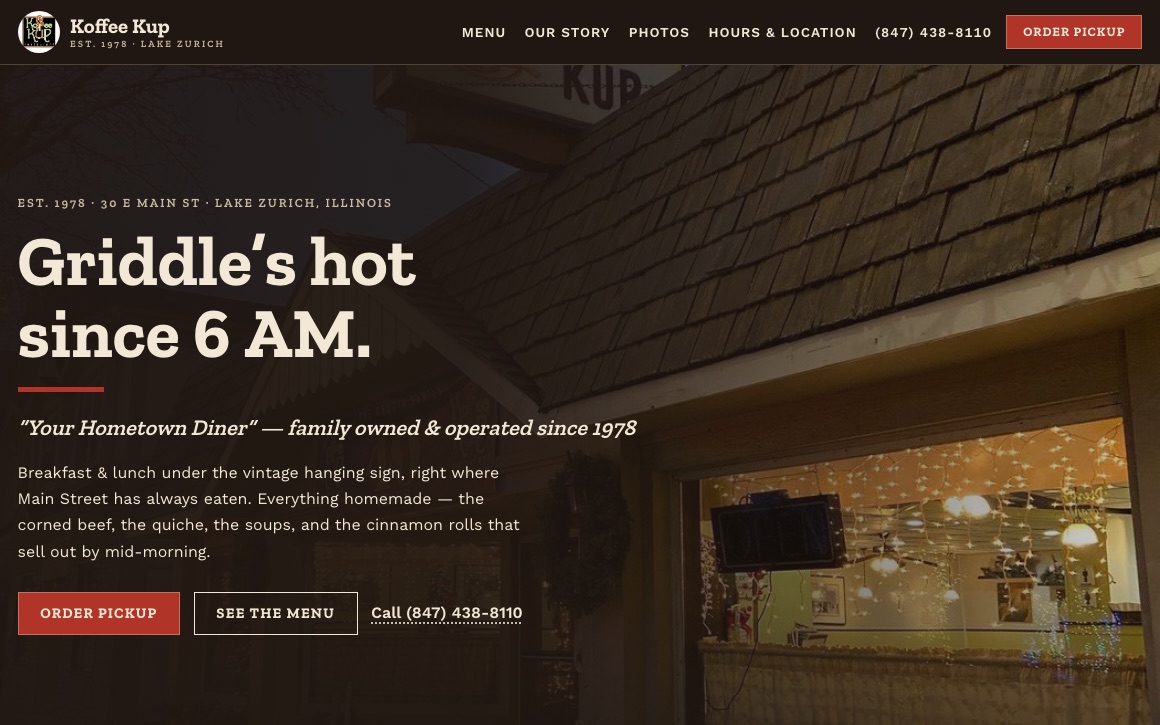
Koffee Kup Diner
Classic diner, Lake Zurich, IL · full site build
koffeekupdinerlz.com →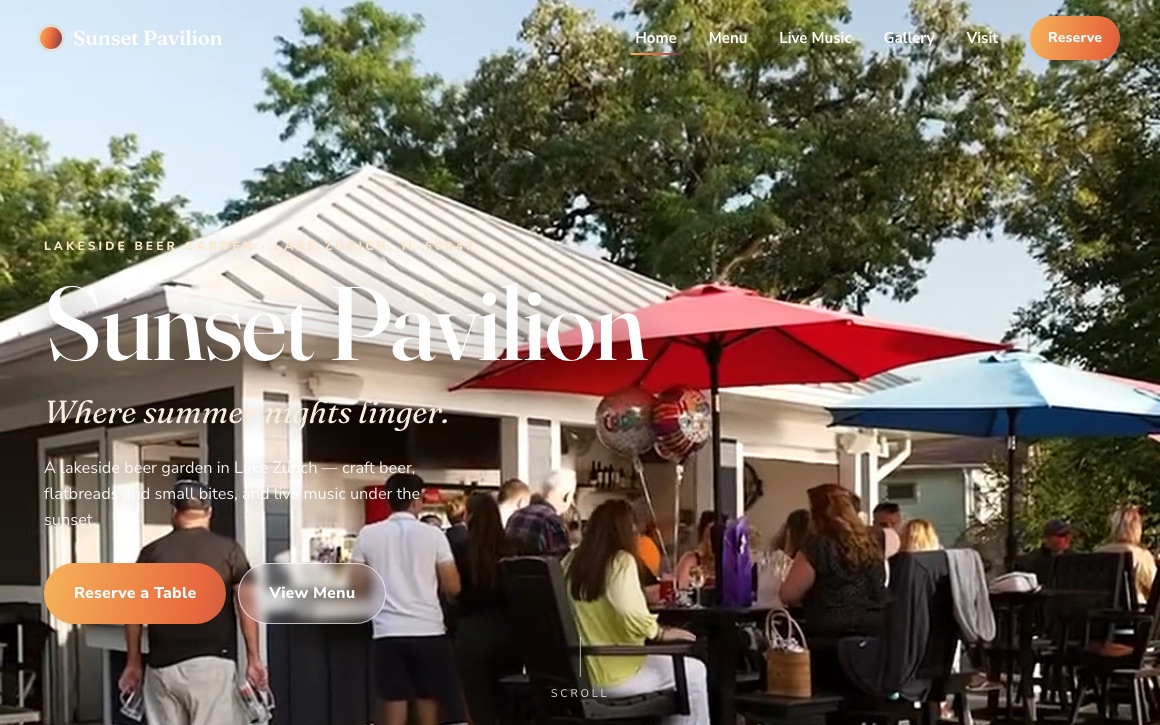
Sunset Pavilion
Lakeside beer garden · site with interactive floor plan
Open the live site →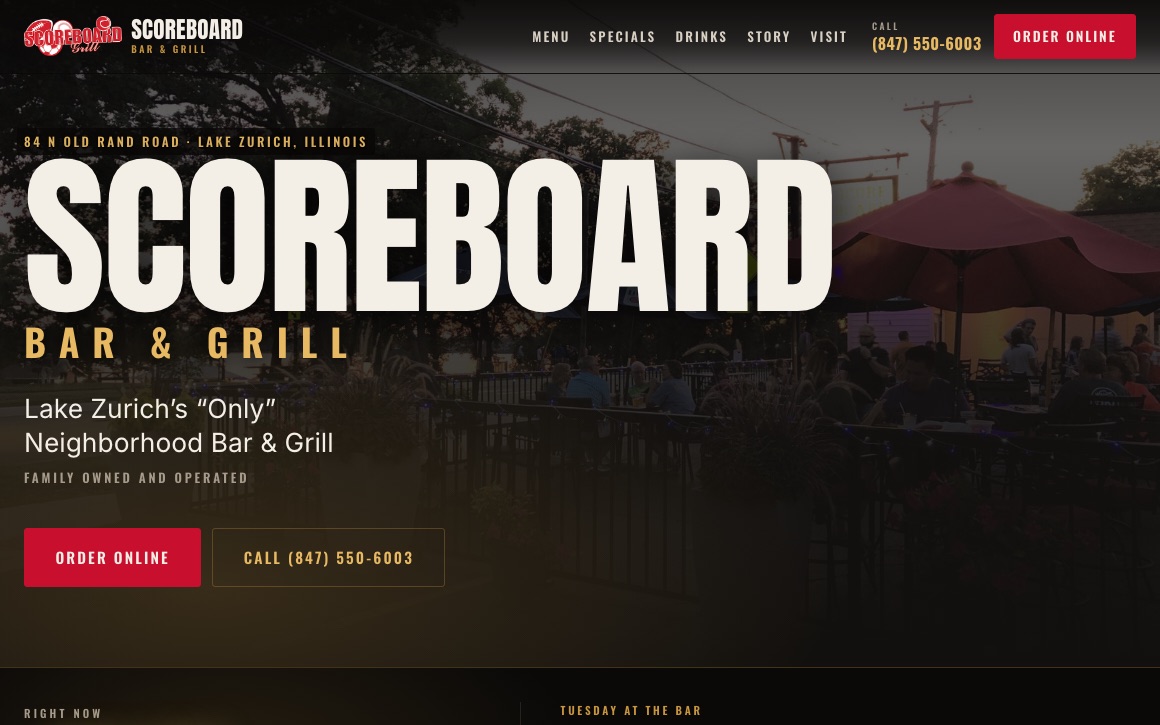
Scoreboard Bar & Grill
Neighborhood bar & grill · full redesign underway
A dated site dragged side by side with its rebuild, then five demo sites you can open and click around: roofing, HVAC, plumbing, a restaurant and an auto shop, all fictional companies, built to the standard a real one gets.
Left, the site a lot of local businesses are still running. Right, what replaces it. Both mockups; the preview we send you uses your actual business.
↔ DRAG · DATED SITE VS. 7-DAY REBUILD
Coquina Crest Roofing
The flagship demo: estimates, storm damage, financing, the works.
View live concept →HVAC concept build
AC repair and maintenance plans, built to book service calls fast.
View live concept →Plumbing concept build
Emergency-first layout: tap to call from anywhere on the page.
View live concept →Restaurant concept build
Menu, hours, and reservations up front. Built to fill tables.
View live concept →Auto repair concept build
Estimates, services, and trust signals. Built to book bays.
View live concept →Fig. 07 · Website pricing
Website pricing. Flat, public, and it does not move.
One build fee, one monthly plan, month to month after launch. The site is yours either way.
This card is the website work, and only the website work. Operations engagements do not run at website prices. They are scoped on the call and priced in the scope document before anything is built. The guarantee below can apply to that work. It never applies to this card.
Launch
A clean, modern site that works.
$750 + $79/mo
- 5-page website, designed and built
- Hosting and security included
- Monthly content edits
- Google Business Profile setup
Growth
Get found by people ready to buy.
$1,250 + $149/mo
- 8 to 10 page website
- Google profile optimization
- Local citations and listings
- Review flow for happy customers
- Monthly report: rankings, calls, leads
AI Visibility
Be the answer AI gives.
$1,500 + $299/mo
- Everything in Growth
- AI-search optimization
- Schema markup across the site
- AI-citation monitoring
- Quarterly "how AI sees your business" report
Nobody can guarantee AI placement. Anyone who promises it is selling something else. We fix what is fixable and show the work in a quarterly report.
Start with a free website reviewFree review and a live preview first, live in 7 days once you approve the direction, then a monthly report of what the site produced.
Fig. 08 · The operations guarantee
Free quote, and a guarantee on operations work.
If what we build does not pay for itself, our fee for building it becomes credit against future work. You cover the hard costs, the software, services and anything bought from a third party to build and run it, and nothing further is owed on the build.
The guarantee applies where your scope document says it does. That document sets how paying for itself is measured and over what window, agreed before anything is built. The answer is arithmetic, not opinion: what this used to cost you to run, what it costs now, and where both figures came from.
- Credit, not cash
- Credit against future work, not cash. It carries no obligation: you can walk away and leave it unused, and you keep what was built.
- Build, not monthly
- Anything billed monthly on an operations engagement sits outside the guarantee. It buys engineering time, and it stands.
- Used as built
- The guarantee holds where the system is run the way it was built. Worked around, or run alongside the process it replaced, it does not apply.
ScopeOperations engagements only. Book the call
Fig. 09 · Start here
Two ways to start.
Bring the last thing that fell through.
Thirty minutes on how a job actually moves through your business. You leave with a shape, a range, and what we still need to see.
Book a 30 minute call →No charge for the call, and nothing is priced until after it.
Or send us the website you have.
Got it. You're in the queue.
Your review + preview link usually lands within 48 hours.
No contract. If the preview isn't obviously better than what you have, delete the email.
Fig. 10 · Questions
Fair questions, straight answers.
What does an operations engagement cost?
There is no card for it, because what gets built is not the same shape twice. The call ends with a shape and a range. The scope document ends with a price, and it is agreed before anything is built. Nothing gets added to it without your name on the change.
Is this automation, or is it software?
The question that separates them: does the thing you need already have a login somewhere? If your apps hold the work and nothing hands it along, it gets built on top of what you already pay for. If no product does the thing at all, something has to be built. Plenty of engagements start as one and turn out to be a bit of both, which is what the call is for.
Why can you not put a price on this page?
Because what can be built turns on whether your systems will let a workflow in. Some publish an open interface, some hold it behind a plan tier or a partner agreement, a few hand out nothing at all. We read your vendors' documentation before we give you a number. That is the first ten minutes of the call rather than a discovery in week three.
Will a machine be sending things to my customers?
No. It reads, sorts, drafts and flags. Nothing reaches your customer without a person. The whole thing is built to fail toward extra review rather than toward a job marked complete.
Do we have to change the software we use?
No, and that is most of the point. You keep what you already pay for, nothing gets ripped out, and nobody has to learn new software. Where a screen gets built, it is read only wherever read only is safer, so there is no second system for your staff to keep updated.
Who owns what gets built?Your accounts, your data and your documentation, outright. The code you keep and run for good.
Every account is in your name from day one. Your data and your documentation are yours outright. You get the code and a repository that stays yours: run it, change it, host it where you like, extend it, and hire anyone you want to work on it, without paying us again. If you stop working with us, nothing switches off and nothing has to be handed back. What we keep is the right to build something like it for somebody else, and that is why this costs what it costs. The website is simpler: the domain, the content and the code are yours.
Why is the website priced when the rest is not?
A website is a known quantity, so it gets a printed number and a delivery date. An operation is not, so it gets a call and a scope document. Anyone quoting the second one off a web page has not looked at your systems.
Is there a contract?
The website build is a one time flat fee and the monthly plan is month to month, cancel any time, the site stays yours. Operations work runs off a signed scope, and work does not start before it is signed.
What is AI search optimization, really?Nobody can guarantee AI placement. Anyone who promises it is selling something else.
When someone asks an assistant for the best roofer near them, the answer is assembled from Bing, Yelp, Foursquare, your business listings and the structured data on your site. We make that pipeline accurate, consistent and complete, then monitor how AI describes your business. Nobody can guarantee AI placement. Anyone who promises it is selling something else. We fix what is fixable and show our work in a quarterly report.
How fast can a website go live?
Most go live within 7 days of the first conversation. The free review and preview usually land within a couple of days.
Start with the thirty minutes.
Bring the last thing that fell through and we will tell you what it would take to stop it happening again. If the answer is that it is not worth building, that is what you will hear.
Or email will@granchidigital.com · call or text (234) 284-3333